You practiced all week indoors. Your throw is dialed. Your bag speed is exactly where you want it. Then you step outside into 85 degrees and 80 percent humidity, and suddenly your bags feel like they're landing in wet sand. Nothing slides the way it should. The fast side that was flying at practice feels sticky and slow. You spend the first two rounds just trying to recalibrate.
Humidity is the single most underrated variable in outdoor cornhole. It affects bag performance more than board condition, wind, or sun angle. And most players find out the hard way — mid-tournament — that their bags weren't built for it.
Here's what humidity actually does to bags, which fabrics handle it best, and the specific Cornographix bags that are engineered to hold up when the air gets thick.
What Humidity Does to Bag Performance
Humidity is moisture in the air, and fabric absorbs it. When a bag's fast side fabric absorbs ambient moisture, the surface texture changes. Fibers swell slightly, the weave tightens, and the coefficient of friction increases. Translation: the bag gets slower. A 9-speed bag in dry indoor conditions might effectively play like a 7 in high humidity outdoors.
The slow side reacts differently. High humidity can actually make some slow side fabrics more aggressive — they grip harder, stop faster, and create less predictable reactions when hit by incoming bags. If your entire game strategy is built around slow-side blockers with a little roll, humidity turns those bags into anchors.
Fill is also affected. Some fills are more porous than fabrics and absorb more moisture over time. A bag left in a bag on the ground during a long outdoor tournament will feel different in round 5 than it did in round 1. Weight changes slightly. The flex of the bag changes. Most players never even notice this happening because they're not testing bags fresh versus mid-tournament.
The fix isn't to throw harder. Adjusting your throw to compensate for humidity mid-game is a losing battle. The real answer is using bags whose fabric chemistry resists moisture absorption in the first place.
Which Fabrics Handle Humidity Best
Every Cornographix bag runs the same tournament-grade build — a dual-weave synthetic fast side and a carpet-hybrid slow side. So this isn't about hunting for a special fabric; it's about knowing how that one build behaves when the air gets thick:
Synthetic Woven Tournament Fabrics
The fast side on every bag is a dual-weave synthetic, and it's the real MVP in humidity. The tight weave limits moisture penetration and the synthetic fibers don't swell the way natural-blend fabrics do. That's not a premium upgrade on select models — it's the standard build across all 100 designs, which is exactly why any Cornographix bag keeps its slide when the air turns to soup.
No Suede, No Weak Link
Here's the myth-buster: we don't put suede on the fast side of anything. Suede's nap drinks up moisture and drags a bag well below its speed-chart rating within the first hour outdoors, so it never makes the cut up front. Every fast side is the same moisture-shedding synthetic — one less thing to sweat through during the semis.
Carpet Slow Sides
Carpet slow sides actually become more reliable in humidity, not less. The grip that defines carpet fabric gets even more aggressive in moist conditions. This is a real advantage if you're playing a blocking game — your slow side blockers become essentially immovable in high humidity.
Rez Fill vs. CX3 in Outdoor Conditions
Fill is the one build variable you actually choose — every bag ships with the fill you pick at checkout (The Rez, CX3, or Slip), and that choice interacts with humidity in ways that matter at the competitive level.
Rez resin fill is generally more consistent across temperature and humidity ranges. The pellets have a closed-cell structure that doesn't absorb ambient moisture. A Rez-filled bag throws in humidity conditions that are very close to its indoor performance — maybe a half-step slower, not a full point on the speed scale.
CX3 fill is slightly more porous and can change feel more noticeably in high humidity over a long outdoor tournament day. The difference is small and most players won't notice it in a single session, but if you're playing six rounds outdoors in August heat, it matters.
Both fills are significantly better than traditional polypropylene pellet fills in humidity. If you're still playing bags with old-school fills at outdoor tournaments, you're starting every humid day at a disadvantage.
Recommended Bags for Outdoor and Humid Conditions
Based on fabric construction and real-world outdoor performance, here are the Cornographix bags that hold up best when conditions turn rough:
Explicit Liberty (7/9) — The top pick for serious outdoor tournament players. Like every bag, the Liberty rides the same moisture-shedding synthetic fast side — but its 7/9 speed is what makes it shine outdoors, because even a half-step humidity slowdown doesn't pull it out of tournament-competitive range. Order it with The Rez fill for the most stable feel and you've got the bag for hot, sticky summer events.
Nympho Two Scoops (6/9) — A step down in speed but more forgiving if you're still developing your throw. The 6 slow side becomes an asset in humidity — that carpet-hybrid grip only gets more dependable as the air turns wet, stopping clean instead of skittering. Solid outdoor bag for intermediate players.
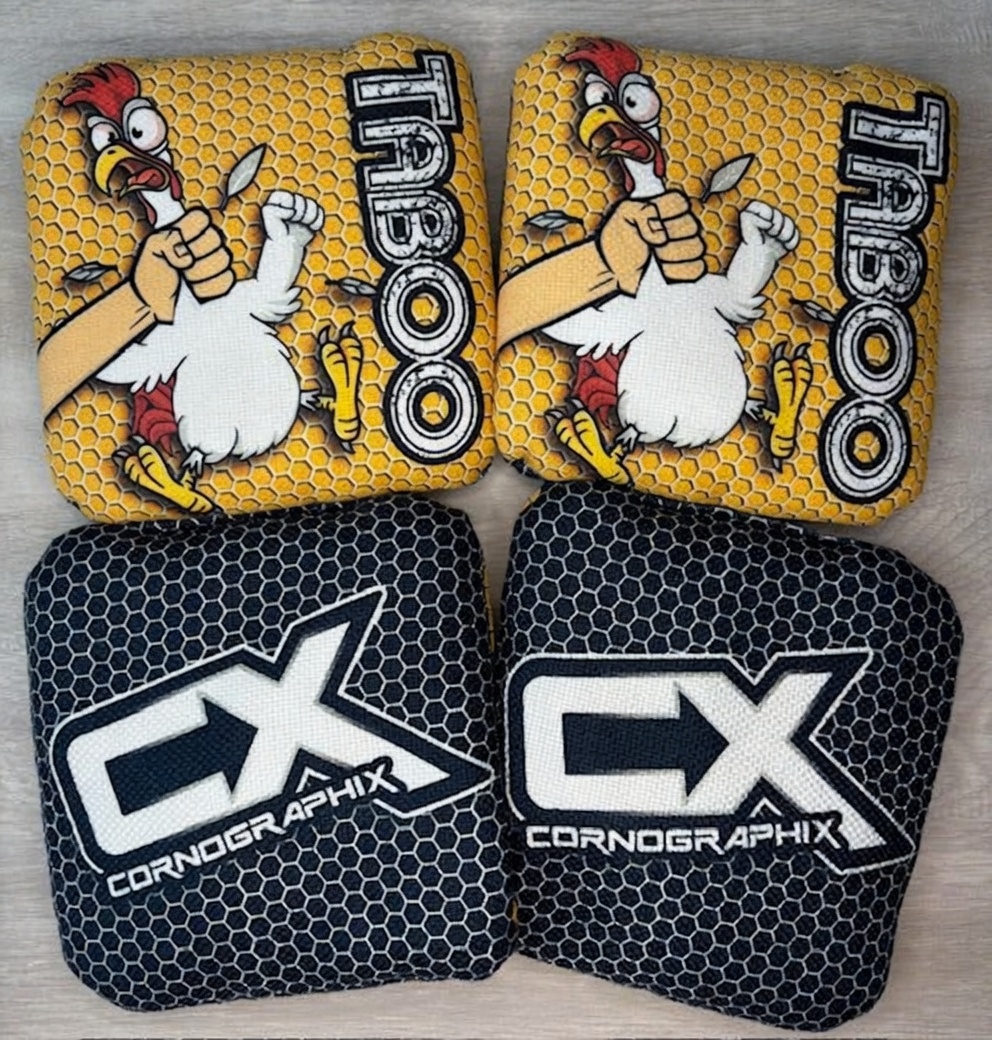
Taboo Chicken (6/8) — If you're playing backyard or recreational outdoor games, not sanctioned tournament play, the Taboo Chicken handles outdoor conditions well and its 6/8 speed range stays consistent across temperature swings.
Tournament day protocol: Keep bags in a bag or case until you're ready to throw. Don't let them sit in direct sun or on wet ground between rounds. Even humidity-resistant fabrics will absorb more moisture over hours of outdoor exposure than they would in a controlled indoor environment.
One More Thing: Board Conditions Matter Too
Humidity doesn't only affect bags — it affects the boards too. An outdoor board that's been sitting in humid air will play slower than the same board indoors. Combined with a humidity-slowed bag, you can be two full speed points off your indoor baseline without any change in your throw.
The players who handle outdoor conditions best aren't the ones who throw harder or adjust their arc mid-game. They're the ones who showed up with bags that were built for it. Check the Cornographix speed chart and note which bags are rated for outdoor conditions — then match that to your playing level and you'll be making smart decisions before you throw your first bag of the tournament.